Configure & Quote ↗
Configure & Quote ↗
Configure & Quote ↗
Calculate luminance contrast between adjacent surfaces using the Bowman-Sapolinski equation. Verify compliance with AS 1428.1 requirements for tactile indicators, stair nosing and wayfinding elements.
Enter the LRV (Y value) of two adjacent surfaces to calculate their luminance contrast percentage. The calculator will determine compliance against AS 1428.1 requirements for each application type.
Different applications require different minimum luminance contrast values to ensure adequate visibility for people with low vision.
For all external installations exposed to weather, LRV compliance must be verified under both dry and wet conditions. Wet testing ensures luminance contrast is maintained when surfaces are wet - a critical requirement for outdoor TGSI and stair nosing. Contact Korb for professional wet LRV testing.
| Application | Min. Contrast |
|---|---|
| Integrated TGSI (tactile ground surface indicator bonded to or part of the substrate) | ≥ 30% |
| Discrete TGSI (individual tactile indicator fixed to the surface) | ≥ 45% |
| Composite Discrete TGSI (discrete indicator with contrasting top surface) | ≥ 60% |
| Stair Nosing (luminance strip on stair tread edge) | ≥ 30% |
Luminance Reflectance Value (LRV) is a measurement of the amount of visible light that a surface reflects when illuminated by a light source. It is expressed as a percentage from 0 (absolute black, absorbing all light) to 100 (perfect white, reflecting all light).
LRV is critical in accessibility design because it determines the luminance contrast between adjacent surfaces - the key metric that allows people with low vision to distinguish tactile indicators, stair nosings, and other wayfinding elements from their surrounding surfaces.
LRV is measured using specialised instruments that quantify how much light a surface reflects:
Tristimulus Colorimeters - measure the Y value (luminance) of a surface using filtered sensors that simulate the human eye's response to light. Commonly used for field measurements.
Spectrophotometers - measure the full spectral reflectance curve and calculate the CIE Y value. Provide higher accuracy and are typically used in laboratory settings.
Both instruments provide the Y (luminance) value needed for the Bowman-Sapolinski contrast calculation.
The Bowman-Sapolinski equation is the standard method for calculating luminance contrast between two adjacent surfaces, as specified in AS 1428.1. It uses the CIE Y values (luminance reflectance) of the lighter and darker surfaces.
This equation accounts for the non-linear response of human vision and provides a percentage contrast value that correlates with how distinguishable two surfaces appear to people with low vision.
Korb provides professional LRV testing as a service for architects, builders and project managers who need to verify luminance contrast compliance on site or during product specification.
Our testing follows the methodology outlined in AS 1428.1 and uses calibrated equipment to provide accurate, repeatable results. We provide a formal LRV assessment report documenting all measurements and compliance outcomes.
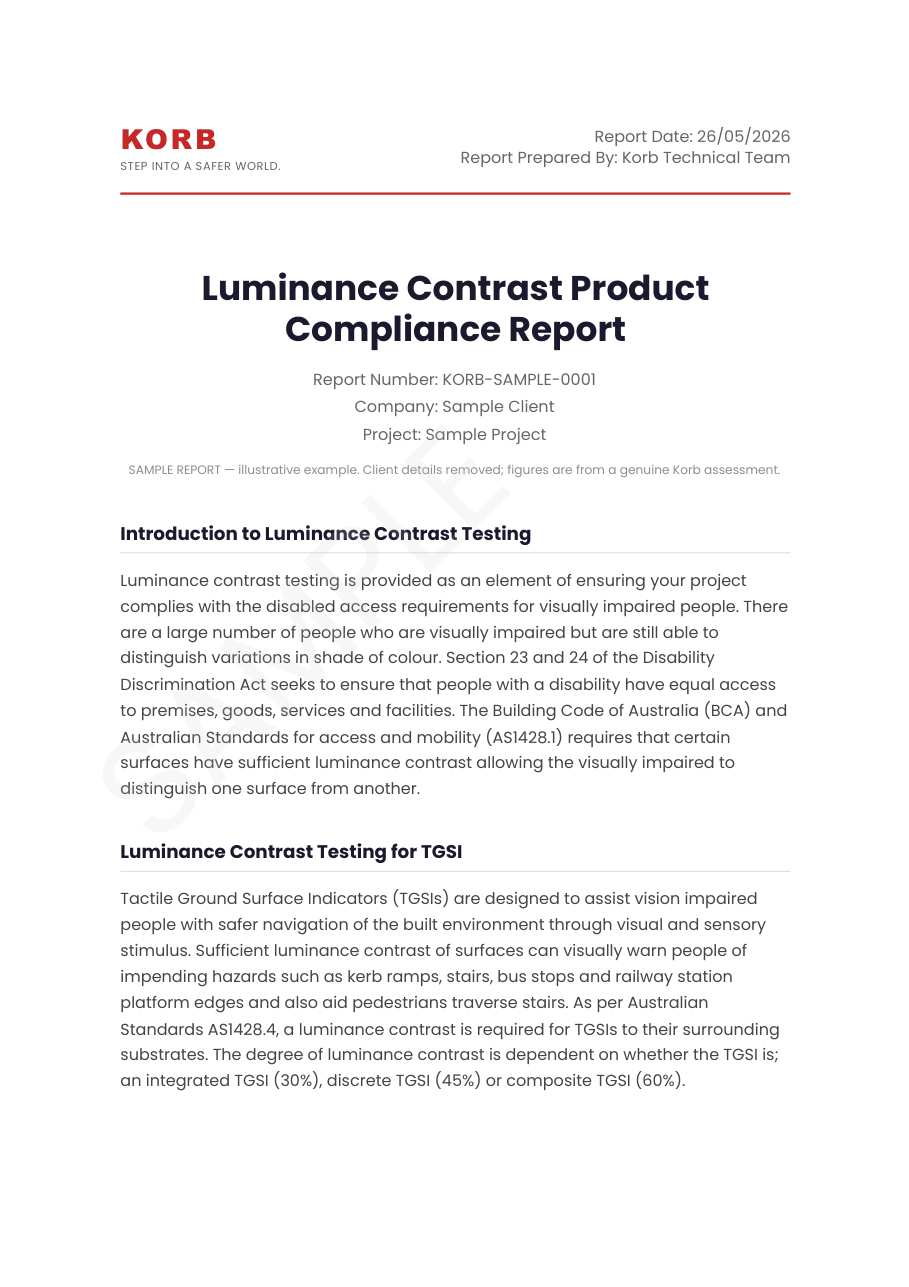
Every LRV assessment includes a formal report documenting all measurements, calculations and compliance outcomes. The report is suitable for submission to building certifiers and access consultants.
Reports include product identification, surface descriptions, individual and mean Y values, calculated contrast percentages, and a clear compliance determination against the relevant requirements of AS 1428.1.
Korb provides professional on-site and laboratory LRV testing across VIC, SA and WA.