 Configure & Quote ↗
Configure & Quote ↗
Configure & Quote ↗
Compliant warning and directional tactile ground surface indicators (TGSIs) for transport, civic and commercial projects. The Nouvel, Renzo and Kahn ranges, integrated tiles, discrete studs and carved formats, tested to AS 1428.4.1:2009 and AS 4586:2013, and listed on the approved TGSI registers for VIC, QLD, WA and SA. Supplied and installed across Victoria, South Australia and Western Australia.
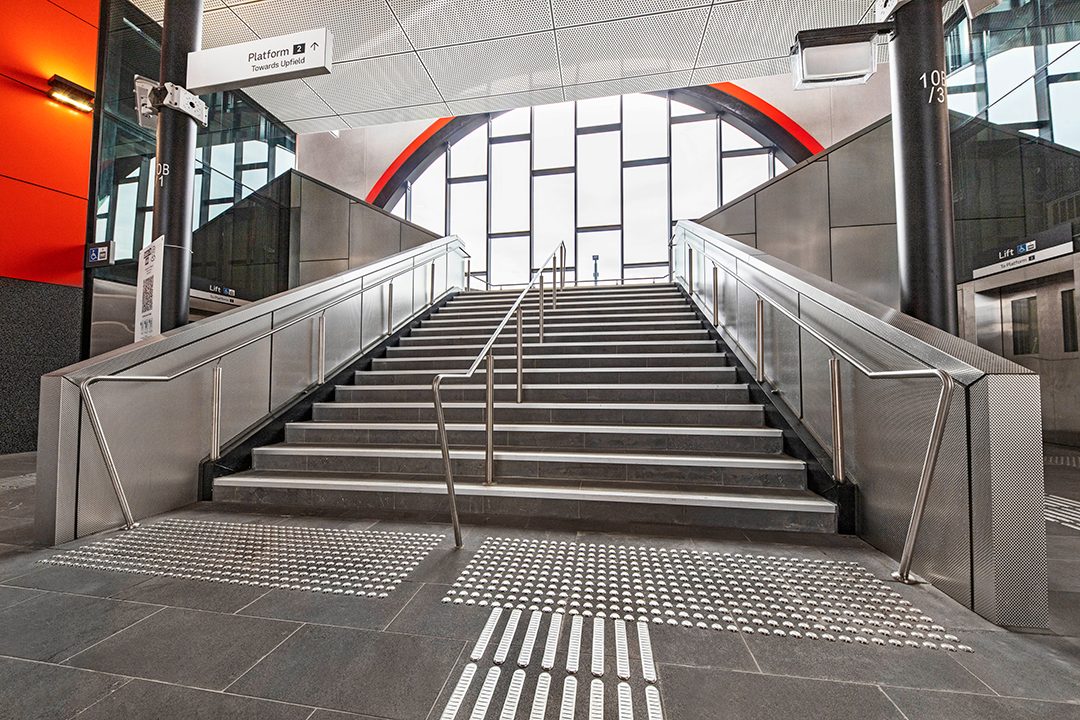

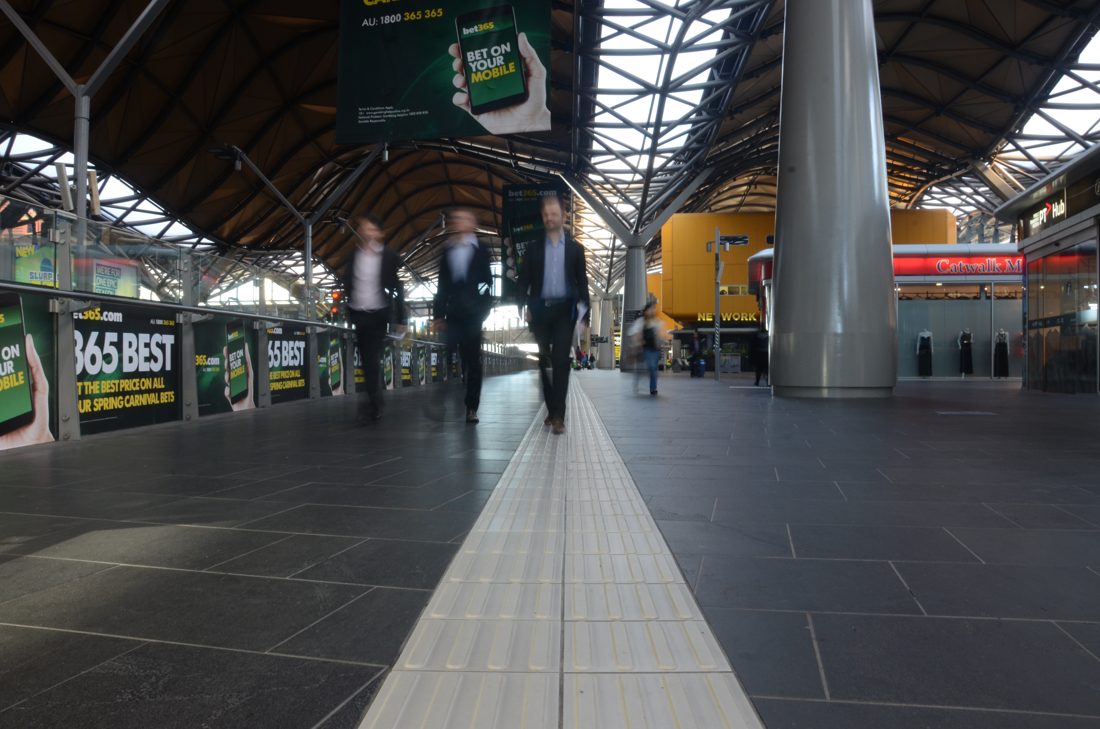

Tactile ground surface indicators, TGSIs, are the raised studs and bars set into the floor that vision-impaired pedestrians read through their feet and a cane. They come in two types: warning indicators (a grid of raised domes) that signal a hazard such as a stair, ramp or platform edge, and directional indicators (raised bars) that guide a safe path of travel.
To be compliant, a TGSI must meet the dimensional and layout rules of AS 1428.4.1, provide the required luminance contrast against the surrounding surface, and carry an AS 4586 slip-resistance classification. On government and transport work the product must also appear on the relevant state's approved TGSI register.
Korb's tactile range spans three families, the polymer Nouvel series, the Renzo integrated tiles and studs, and the Kahn modular, porcelain and solid-carved formats, covering both warning and directional indicators in integrated, discrete and carved installation types.
Every product is available supply-only or as a full supply-and-install package, with set-out and placement detailed to AS 1428.4.1 so it passes inspection the first time.
A tactile ground surface indicator is only compliant if it reads correctly underfoot and through a cane, which is why the dimensions are tight and are measured on the installed product rather than the sample. Warning and directional indicators are never interchangeable: the dome grid signals a hazard, the bar pattern signals a path.
| Dimension | Warning (truncated dome) | Directional (truncated bar) |
|---|---|---|
| Height above base | 4 to 5mm | 4 to 5mm |
| Top dimension | 25mm diameter, plus or minus 1 | 17mm width, plus or minus 1 |
| Base dimension | 35mm diameter, plus or minus 1 | 35mm width, plus or minus 1 |
| Spacing, centre to centre | 50mm, plus or minus 1 | 75mm, plus or minus 5 |
| What it signals | A hazard ahead: a stair, a ramp, a platform edge or a crossing. | A safe path of travel, with the bars laid parallel to the direction of travel. |
This is where most TGSI specifications come unstuck. The minimum contrast is not a single number: it depends on how the indicator is constructed. All three are calculated with the same Bowman-Sapolinski equation against the actual adjacent floor finish, sealed and installed, rather than against a product sample.
| TGSI type | Minimum contrast against the adjacent floor |
|---|---|
| Integrated | 30%. A single piece where the base and the dome are the same material, such as an integrated tile. |
| Discrete | 45%. A standalone stud of uniform colour, drilled and fixed individually into the substrate. |
| Composite discrete | 60%. A stud with a contrasting top, for example a silicon carbide insert. Specifying these at the 45% discrete threshold is one of the most common inspection failures. |
| Outdoor installations | The threshold has to be met both wet and dry, and the worst condition governs. |
Setback drift is the second most common failure on site, usually an install at 250mm or 350mm where the standard sets 300mm plus or minus 10. These are the placements that appear on almost every commercial and transport project.
| Location | Set out |
|---|---|
| Top and bottom of stairways | Warning indicators 300mm, plus or minus 10, from the outer leading edge of the nosing. Depth 600 to 800mm, full width of the path of travel. |
| Ramps steeper than 1:14 | Warning indicators at the same setback and depth. Where a ramp is bounded by continuous handrails that extend onto the landing, indicators are not required at that end. |
| Escalators and travelators | Warning indicators 300mm, plus or minus 10, measured from the end of the moving handrail, not from the comb plate. Measuring from the comb plate is a recurring inspection failure. |
| Railway platform edges | Warning indicators set back 600mm from the edge, because the hazard is falling rather than descending, and run the full length of the platform. |
| Intermediate stair landings | Required only where a handrail is broken. Continuous handrails on both sides waive the requirement. |
| Kerb ramps and crossings | Warning indicators at kerb ramps, pedestrian crossings, and beneath overhead obstructions lower than 2000mm headroom. |
| Open spaces | Directional indicators where the accessible path is not defined by walls, kerbs or landscaping. Minimum 300mm wide, which is 4 bars, laid parallel to the line of travel. |
| Mid block crossings | Directional indicators leading from the accessible path to the warning indicators at the crossing edge. Minimum 600mm deep, which is 8 bars, where the path is approached at an angle. |
Korb supplies and installs tactile indicators from three locations: Melbourne in Thornbury, Adelaide in Thebarton and Perth in O'Connor, covering Victoria, South Australia and Western Australia. Every range is available supply only for a builder's own installer, or as a full supply and install package with the set out detailed to AS 1428.4.1 so it passes inspection the first time. Slip classification and luminance contrast evidence are issued with the order.
Get a quote, request samples or talk to us about supply and install across VIC, SA and WA.

